


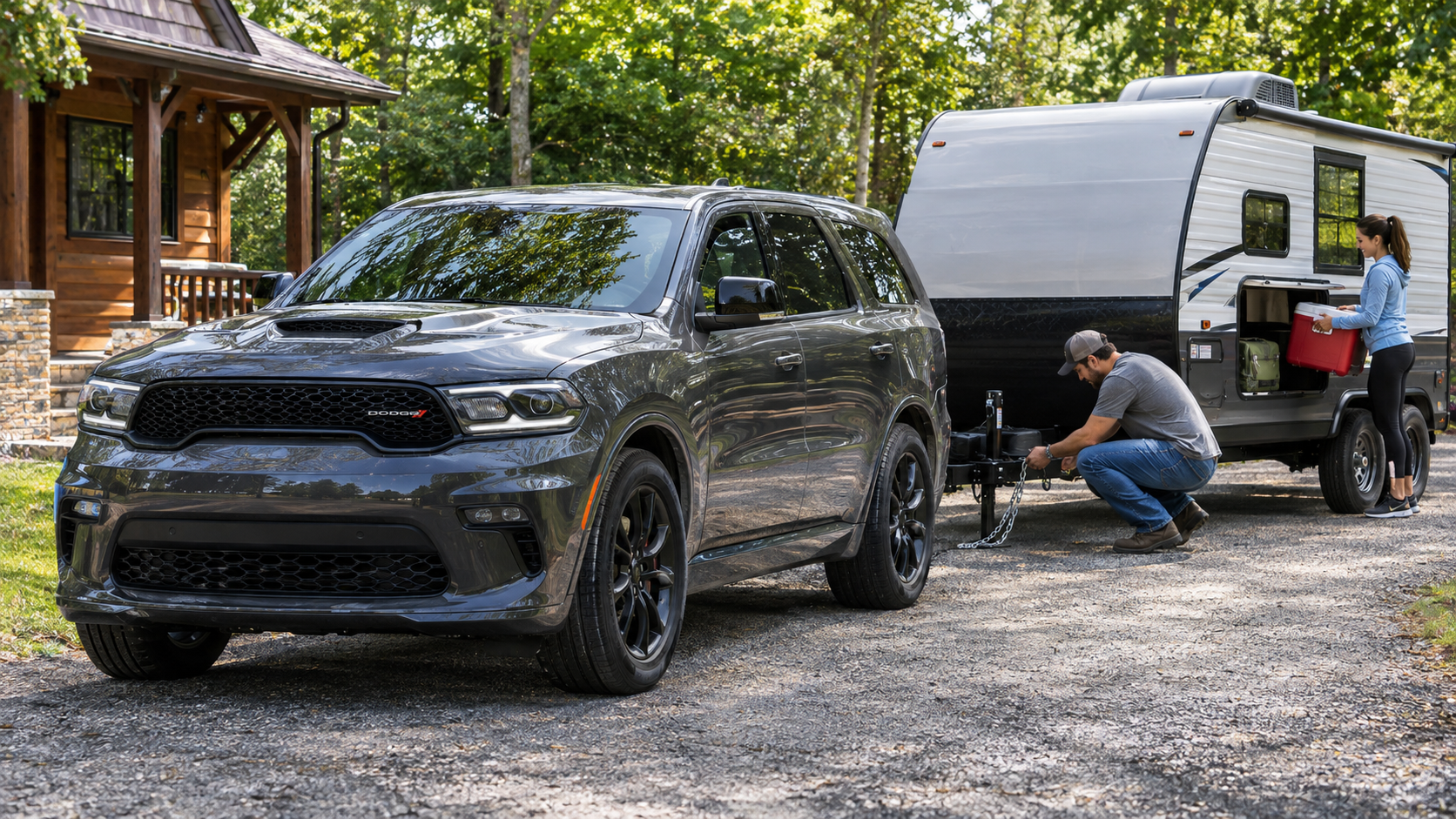
You have a camper in mind and want to know whether a Durango can pull it. Dodge Durango towing capacity changes with the engine, drivetrain, factory equipment, and weight carried inside the SUV. How can you tell whether a particular Durango suits your trailer? Start with its verified tow rating, then check the trailer's loaded weight and the SUV's other weight limits.
How Dodge Durango Towing Capacity Changes by Configuration
A published maximum towing rating describes a specific vehicle setup, not every Durango on the lot. Dodge publishes an available maximum of 8,700 pounds for properly equipped 2026 Durango configurations. However, other configurations have lower limits. Therefore, an engine badge or trim name alone cannot establish what a particular SUV can tow.
Why do tow ratings differ between Durangos? Dodge evaluates combinations of engine, drivetrain, cooling equipment, and factory towing components. A Pentastar V6 configuration and a HEMI V8 configuration may carry different ratings. Additionally, two Durangos with similar engines may have different towing equipment or drivetrains. Each detail can change the manufacturer's published specification.
For a Durango with the 3.6-liter Pentastar V6, check the appropriate rating for its cooling and towing equipment. On a 5.7-liter HEMI V8 model, verify the drivetrain and any factory towing package. If you are considering a Durango with Tow 'n Go, confirm that package through its factory equipment record. Instead of applying a model-wide maximum, match the published specification to the exact vehicle.
Additionally, the vehicle identification number, or VIN, identifies the Durango you are evaluating. Therefore, ask the dealership to confirm its equipment and applicable owner's manual specifications. This gives you a sound starting point before weighing a trailer.
Why Trailer Weight and Tongue Weight Matter
A trailer's advertised dry weight is not necessarily its weight when you leave for a trip. Food, water, tools, camping supplies, and other cargo add weight. Therefore, compare the Durango's verified limit with the trailer's actual loaded weight. In addition, the trailer's gross vehicle weight rating establishes its maximum permitted loaded weight.
For this reason, four measurements deserve separate attention when assessing a camper or boat trailer:
- Loaded trailer weight: Include the trailer and everything carried inside or attached to it. This is the weight you must compare with the Durango's tow rating.
- Tongue weight: The trailer places downward force on the hitch. That force also counts toward the SUV's permitted load.
- Vehicle payload: Passengers, luggage, and trailer tongue weight all use part of the Durango's available carrying allowance. Check the vehicle's tire and loading label.
- Vehicle weight ratings: The Durango's gross vehicle weight rating limits its loaded weight. Its combined weight rating governs the loaded SUV and trailer together.
Does adding passengers change how much trailer weight you can safely pull? It can restrict the remaining load allowance inside the SUV. For this reason, a family traveling with luggage must count those items alongside tongue weight. Therefore, a towing setup needs to meet every relevant limit, not solely the headline trailer rating.
How Dodge Durango Towing Equipment Works
First, a hitch connects the trailer to the Durango. However, the receiver is only one part of a towing setup. Additionally, wiring connects the SUV's electrical circuits to the trailer's lights. For trailers with electric brakes, a compatible brake controller sends braking commands to the trailer. Furthermore, cooling components manage heat created by engine and transmission demands while towing.
Dodge offers factory towing equipment through packages such as Trailer Tow Group IV and Tow 'n Go. Their included components and availability vary by model year and configuration. Therefore, check the exact factory equipment list before assuming a Durango has everything needed.
Pay attention to these four items when checking a specific SUV:
- Receiver hitch: Verify the installed receiver and its rated limits. A hitch rating does not override the Durango's manufacturer tow rating.
- Trailer wiring: Confirm that the electrical connector suits the trailer's lighting and brake requirements. The connector type must match the trailer setup.
- Brake controller: Ask whether the Durango has a compatible integrated controller or needs another approved solution. Trailer braking requirements also vary by trailer and jurisdiction.
- Cooling equipment: Confirm the factory cooling setup required for the vehicle's published rating. Adding a hitch cannot substitute for missing manufacturer towing equipment.
Can an aftermarket hitch increase a Durango's tow rating? No. A stronger receiver cannot change the manufacturer's rating for the vehicle. Furthermore, the weakest applicable weight limit still controls the combination. Therefore, ask for the factory equipment record before relying on an accessory description.
Matching a Dodge Durango to a Camper or Boat Trailer
A camper and a boat trailer place different demands on a tow vehicle. For instance, a camper may carry water, propane, food, and luggage. By contrast, a boat trailer may carry fuel, safety gear, and equipment in addition to the boat itself. Therefore, the weight printed on an empty trailer is only the beginning of the comparison.
Can a Dodge Durango tow your camper? It may, if the fully loaded trailer and hitch load fit the specific Durango's ratings. Water and gear can raise a camper's weight before departure. Instead of relying on its dry-weight label, request a realistic loaded-weight figure. Additionally, a loaded trailer scale measurement provides a clearer comparison when available.
For a boat, confirm the combined weight of the hull, motor, trailer, fuel, and equipment. Next, check how the trailer transfers weight onto the Durango's hitch. Additionally, count everyone and everything riding inside the SUV. A trailer may sit below the tow rating while the Durango exceeds its payload or vehicle weight limit.
Furthermore, hitch setup and trailer stability deserve attention. Therefore, follow manufacturer instructions for coupling, loading, brakes, and any required weight-distribution equipment. Your configuration must support the complete towing arrangement, not merely the trailer's advertised weight.
What to Verify Before Choosing a Dodge Durango
Once you know your trailer's loaded weight, compare it with a specific Durango instead of a trim-level assumption. First, check the model year, VIN, engine, drivetrain, and factory towing package. Next, review the manufacturer's rating and the weight labels for that SUV. Additionally, the dealership can clarify which equipment appears on a listing before you make a decision.
With that in mind, use these questions to guide the final check:
- Which tow rating applies to this VIN? Ask for the exact model-year specification and factory towing configuration. Do not substitute the lineup's maximum figure.
- Which towing components came from the factory? Confirm the receiver, wiring, controller, and required cooling equipment. Check each part against your trailer's needs.
- What is the Durango's remaining load allowance? Review the loading label and account for occupants, luggage, and tongue weight. Do not evaluate trailer weight alone.
- What does the loaded trailer weigh? Include water, fuel, gear, and installed accessories. Compare the loaded figure with the applicable trailer and vehicle limits.
- Are the vehicle and trailer matched correctly? Verify hitch limits, connections, brake requirements, and manufacturer instructions before towing. Ask about anything the listing does not establish.
Therefore, a Durango selected for weekend camping should support the trailer and the people traveling with you. Browse the new vehicle inventory to identify configurations worth reviewing. Then contact Ross Downing CDJR of Mobile to confirm its factory equipment and published towing specifications.